Chevrolet Corvette (1963–1967)
History
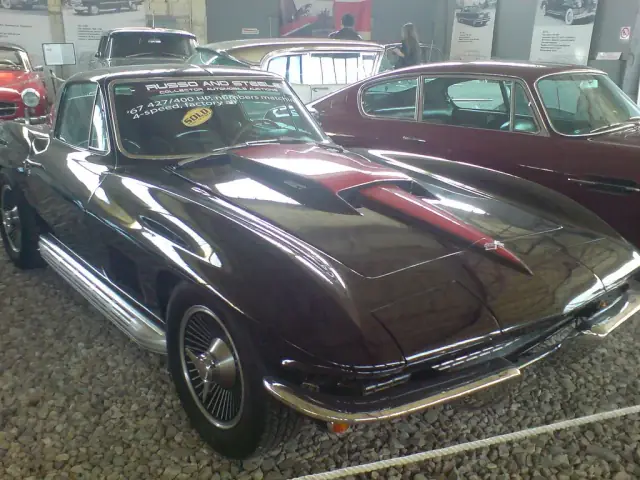
In the early 1960s the Corvette gained muscle: the small-block V8 grew and in 1963 the Sting Ray, shaped under Bill Mitchell’s direction, revolutionised its silhouette with pop-up headlights and independent rear suspension. Fibreglass body, here a 5.4-litre 327 V8 with 350 hp, 200 km/h: America finally had a world-class sports car.
Specifications
| Production | 1963–1967 |
|---|---|
| Engine | 5.4 L V8 |
| Power | 350 hp |
| Torque | 488 Nm |
| Top speed | 200 km/h |
| Weight | 1,402 kg |
| Weight-to-power ratio | 4.0 kg/hp |
| Driven wheels | Rear-wheel drive |
| Gearbox | Manual |
| Country | United States |
| Category | GTs |
Rankings
| Criterion | Among Chevrolet models | In the whole catalogue |
|---|---|---|
| Power | 5th of 27 | 105th of 1,295 |
| Top speed | 3rd of 16 | 364th of 1,155 |
Rarity
The 1960s Sting Rays are among the most valuable Corvettes, led by the 1963 split-window coupés. In the game it ranks among the exceptional cars.
Did you know?
The 1963 coupé’s split rear window lasted just one year: engineer Zora Arkus-Duntov considered it a hazard to visibility and had it removed.