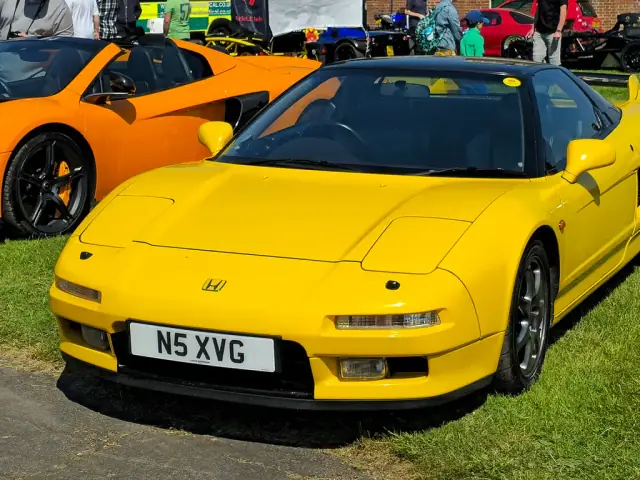
Honda NSX (1997–2005)
History
A Japanese supercar launched in 1990 to challenge Ferrari, the NSX pioneered the all-aluminium monocoque in series production. From 1997 its V6 grew to 3.2 litres and 280 hp, Japan's official ceiling, with a six-speed manual; the 2002 facelift dropped the pop-up headlights. Easy to live with and precise, it has aged without a wrinkle.
Specifications
| Production | 1997–2005 |
|---|---|
| Engine | 3.2 L V6 |
| Power | 280 hp |
| Torque | 304 Nm |
| 0–100 km/h (0–62 mph) | 5.7 s |
| Top speed | 274 km/h |
| Weight | 1,464 kg |
| Weight-to-power ratio | 5.2 kg/hp |
| Driven wheels | Rear-wheel drive |
| Gearbox | Manual |
| Country | Japan |
| Category | Youngtimers |
Rankings
| Criterion | Among Honda models | In the whole catalogue |
|---|---|---|
| Power | 1st of 23 | 174th of 1,295 |
| Top speed | 1st of 16 | 60th of 1,155 |
| 0–100 km/h (0–62 mph) | 1st of 12 | 70th of 863 |
Rarity
Hand-assembled over fifteen years, fewer than 20,000 in all, it has become a must-have among 1990s collectables. In the game it is an exceptional-tier car.
Did you know?
Ayrton Senna tested the prototype at Suzuka and found the chassis too soft, so Honda stiffened it before production.